
Stylized Water 3 - Underwater Rendering (Extension)
10.Performance Guidelines

General
Whilst above water, a check if performed across all Underwater Area components if the camera’s frustum intersects with it.
This is very fast to perform, even for hundreds of instances.
- Only relevant cameras are checked (exluding hidden or special cameras).
- A broad-phase check using a sphere is first used, if the camera isn’t even inside of it.
- If multiple areas intersect, the one with an edge nearest to the camera gets used.
Only once the camera frustum interects with an Underwater Area does any rendering take place.
Mobile VR
On this platform, it’s important to understand how the URP’s Opaque Texture affects performance.
The opaque texture is mainly used for two visual effects:
-
Refraction on the water surface (distortions when looking through the water)
-
Blending the underwater color and fog with the environment
However, enabling this feature means the engine has to copy the entire screen image at full resolution, which is typically very slow on hardware that uses tiled rendering (eg. Meta Quest, and many modern devices).
Recommended settings for best performance
- On the Stylized Water 3 render feature, set the “Render Method” to Scene Renderer
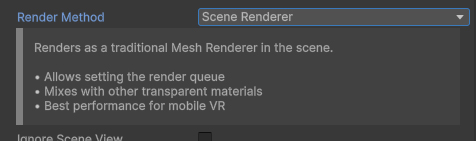
This method renders the underwater shading as a regular Mesh Renderer, thus avoids writing into the screen buffer an additional 2 times -
In your Render Pipeline Asset, turn off the Opaque Texture option.
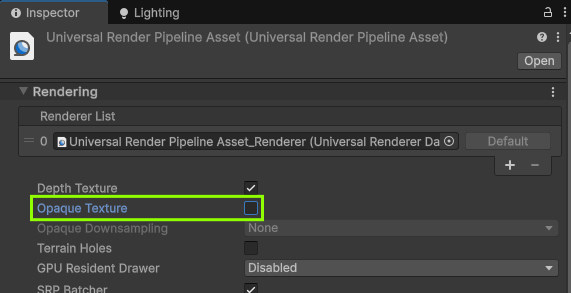
-
In your Water Material, turn off the Refraction effect and Directional Projection for caustics.
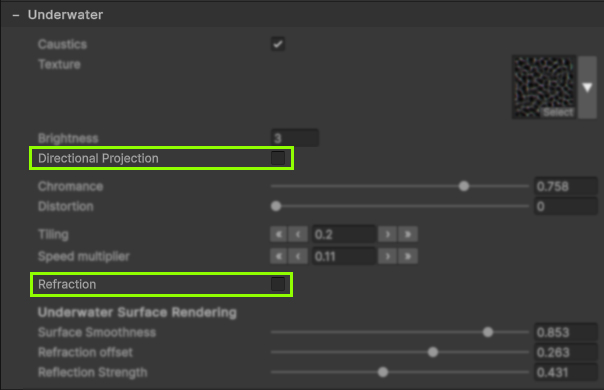
Disabling these features will reduce the visual quality slightly, as the water surface no longer appears to distort the scene, but will significantly improve performance on mobile platforms.
 Was this helpful?